Daylight Saving Time (DST) was initially proposed by George Vernon Hudson (1867-1946), a New Zealand entomologist and astronomer. Although the idea was first referenced by Benjamin Franklin in 1748 in joking remarks to a letter from France about saving daylight.
What is Daylight Saving Time ?
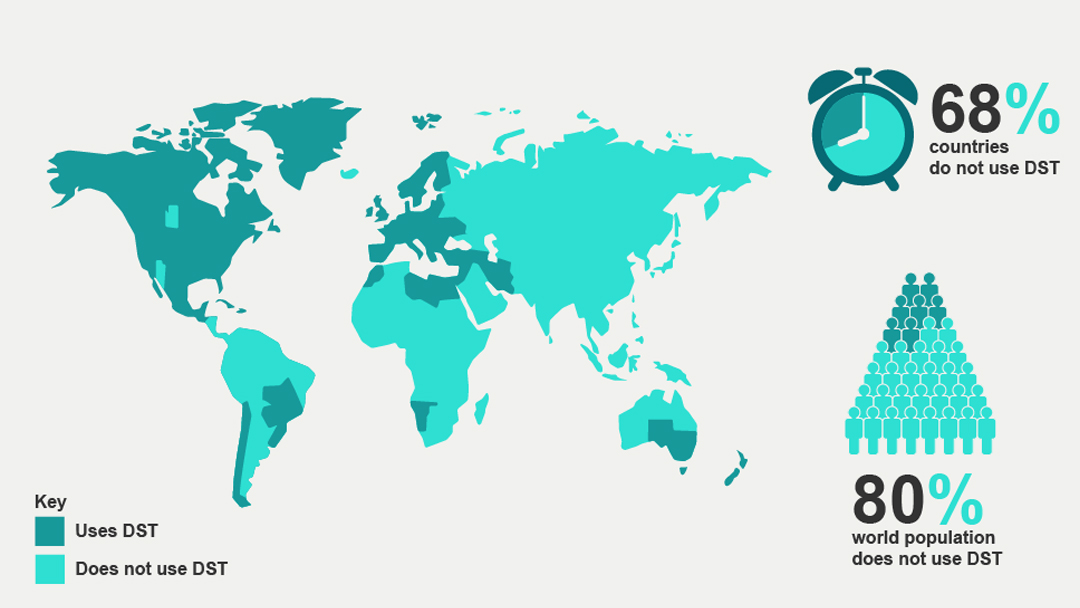
During seasonal change clocks are set ahead of standard time, in order to make usage of daylight and conserve energy also known as Daylight Saving Time. Usually the alternation is made during the summer by an hour or two. Worldwide at least 40% of countries, use DST as a measure to preserve energy, but does it really work? If yes, why is DST still unpopular in the rest of the world ?

How did Daylight Saving Time began ?
Well it all began with the love for insects. George, the renowned entomologist and acclaimed author of “The Butterflies and Moths of New Zealand” frustration grew during the summer time. As his job in Wellington post interfered with his bug collection. Hence he came up with a solution to shift the clock two hours ahead in Summer time and revert back to regular time during the winter. In his proposal he stated,
Although his colleagues acknowledge the benefits of DST, they persisted it would interfere with the system that has been in place for thousands of years.
Many to this day credit the Daylight Saving movement to Benjamin Franklin and his satirical letter, in 1784 ” the Journal de Paris.” However, his solution was never to implement an alternation in the standard time. Benjamin wanted to use unusual methods such as firing canons to wake up residents, limitation in the candle purchase and even taxing shuttered windows.
Furthermore, William Willett wrote about Daylight Saving Time in his pamphlet The Waste of Daylight. His campaign managed to gain attention of the British Parliament and even convinced them to consider the proposal in 1908, however the bill didn’t pass.

The relation between World War I and Adoption of Daylight Saving Time
Fast forward World War I, German were low on the resources, hence they decided to adopt daylight saving in order to make use of more daylight hours and conserve energy. Soon followed by United Kingdom, France and finally the United States.
Summer Time to British Summer Time
During the second world war the UK made an alternation in the name. The Daylight Saving was then known as Summer time and later as British Summer Time. The clocks were set two hours ahead of GMT during the summer and an hour ahead in winter.
US adoption of Daylight Saving Time
The US also adopted Daylight saving prominently during the World War II. Although states had the freedom to make the choice-whether to introduce the DST or not. Which added more confusion among the people.
In 1996 the Uniform Time Act of US stated the DST schedule will start from Sunday of April and end by last Sunday of October. During the global energy crisis a year-round DST was introduced in the winters (1973-74) as well; which was reverted back to standard time, in 1974 winter.
So, does the Daylight Saving Time helps as anticipated ?
Well, Yes and No, a little bit of both.
According a 2008 study done by US Department of Energy the Daylight Saving Time saved 0.5 % electricity in total per day. However, many conclude, DST is total waste, Why ? Although the later bright sun hours may reduce the energy consumption; the air conditioning during the evening and increased light consumption in the early morning hours prevails over any saved energy.
Besides that, the slightest change in routine tends to result in missed meetings, groggy and sleepy residents. Studies identify the Daylight Saving Correlation with increased risk of heart attacks, as well as fatal car accidents; though the reported accidents are relatively small in terms of total car accidents every year. Lack of sleep is also known to result in compromised immune system.
Another study points out, Daylight Saving Time, demanded an increase in energy supply and pollution in Indiana. While in Norway and Sweden, DST resulted in slight reduction in the energy consumption.
Pros :
- Slight Reduction in Energy Consumption.
- 0.5 % energy saved per day in the course of four weeks DST.
- Boost in outdoor evening activities such as: indulging sports, taking kids playground, barbecue gatherings etc.
Cons:
- Correlation with Heart Attacks and compromised immune system.
- Fatal car accidents.
- Inefficiency in work hours.
- Higher energy demand to light dark mornings and air conditioning in the evening hours.
Who are in the favor of the Daylight Saving Time ?
- Outdoor industries such as, Golf and barbecue.
- Petroleum industries as people tend to travel a lot after work and school.
A survey done in Europe showed 80% respondent were against DST, same in America, residents are pushing to stop the Daylight Saving Time.
Now that you understand Daylight Saving; what are your thoughts in DST ? Should it be adopted by the rest of the world?
Lets us know in the comment section.
Please SHARE with your friends and family.



Right on my man!
That’s very good point